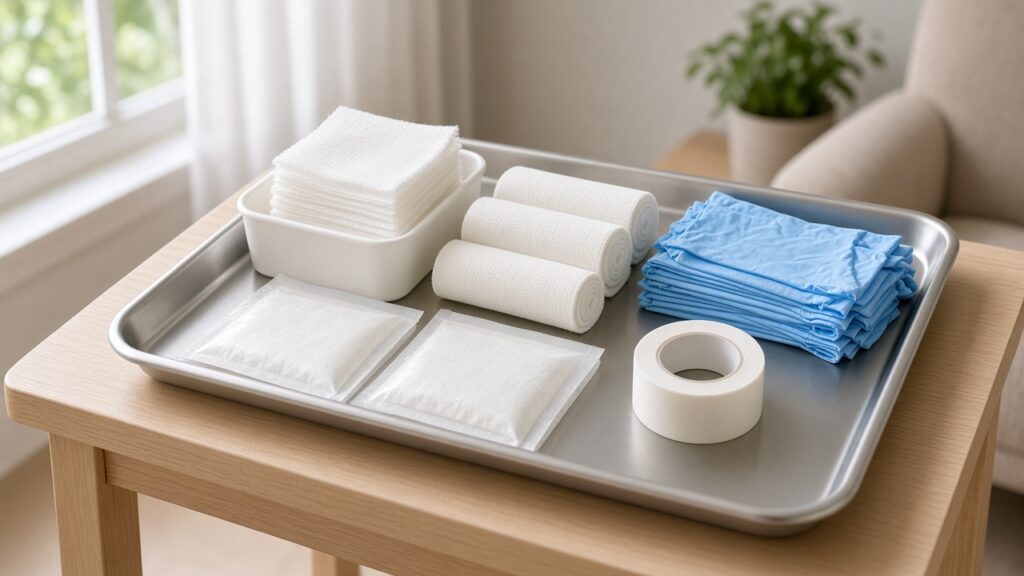
A wound that needs professional care does not always require a hospital stay. After surgery, or when a pressure injury or other wound will not heal easily, a nurse may provide skilled care in the residence. Families often mix up that nursing visit with the help a home health aide can give. They also often assume Medicare will pay for as long as the wound takes to heal. The rules for wound care at home in NYC are more specific than that.
This guide explains wound care and skilled nursing visits at home. It also covers what Medicare may cover, and how Nursing Personnel can help. It is general information, not medical advice or a coverage decision. Follow the plan from the person’s doctor or wound-care specialist. If you would like to talk about nursing visits or aide support, contact Nursing Personnel Home Care.
When wound care at home in NYC needs a nurse
Skilled nursing is care that requires a licensed nurse’s training and judgment. Medicare.gov lists wound care for pressure sores or a surgical wound as an example of skilled nursing that may be covered at home. Other examples include patient education, intravenous or nutrition therapy, injections, and monitoring of a serious illness.
A home health aide is not a substitute for that nursing care. An aide can help with bathing, dressing, meals, and mobility so the person can rest and follow wound precautions. In New York, a home health aide may assist with certain limited tasks, such as a clean dressing on a stable surface wound, when the written care plan and nurse supervision allow it. Sterile procedures, assessment of a complex or infected wound, and decisions about treatment belong to the nurse and the doctor. If you are comparing roles, see our article on home health aides versus personal care aides in New York.
Nursing Personnel’s skilled nursing care page describes private duty nursing in the home, a hotel, or a skilled nursing facility, as well as nursing visits for wellness, medication management and pre-pours, or wound care. A case may be a short visit, a series of visits, or a longer private-duty shift. That depends on the order, the wound, and how you arrange payment.
What Medicare may pay for — and what it may not
Medicare may cover home health services, including skilled nursing for wound care, when the person is homebound and needs part-time or intermittent skilled care. A doctor or other qualifying provider must order the care, and a Medicare-certified home health agency must provide it. If the person meets those rules, the person pays nothing for the covered home health services. After the Part B deductible, Medicare generally pays 80% of the approved amount for covered medical equipment.
In most cases, “part-time or intermittent” means skilled nursing and home health aide services combined may run up to eight hours a day, for a maximum of 28 hours a week. For a short time, coverage can rise to 35 hours a week if a provider decides it is necessary. Medicare does not pay for 24-hour care at home. It does not pay for personal care when that is the only help needed. You will not qualify for this Medicare benefit if you need more than part-time or intermittent skilled care. Our comparison of Medicare and Medicaid for home care in New York walks through those limits. After hip or knee surgery, the same Medicare home health rules may apply. See our guide to home care after hip or knee surgery.
This article does not claim that Nursing Personnel has Medicare home health certification. When Medicare coverage applies, you arrange it through an agency that meets those certification rules. Families who need nursing visits or private duty nursing outside that benefit, or after it ends, often use private pay or other insurance. If the person qualifies, Medicaid may also help.
Private duty nursing, Medicaid, and combining aide support
When a person needs more continuous nursing than intermittent visits can provide, New York Medicaid may consider private duty nursing for members who meet the rules. The state’s consumer guide says a certified home health agency generally provides nursing only part-time or intermittently. Typically fewer than two hours per service authorization. And that private duty nursing is not for non-skilled personal care alone. Medicaid requires prior approval, and Medicaid is the payer of last resort. Details are in that official guide and in our pediatric home care article, which also discusses children who need nursing at home.
For adults who need ongoing help with daily activities as well as wound care, Medicaid personal care or a Managed Long-Term Care plan may arrange an aide, while nursing visits address the wound. Our guide to qualifying for Medicaid home care in New York City explains how to start that process. Private-pay nursing visits or aide hours can fill gaps while you and the plan decide coverage, as described in our article on paying for a home health aide in NYC.
Watching the wound and asking for help early
The nurse and doctor should tell you how often to change the dressing. They should also tell you how to keep the area clean and dry, and which warning signs to report. In general, call the clinician if the wound has increasing redness, a foul smell, drainage that is getting worse or lasting longer than expected, the wound is opening, pain is increasing, or there is a fever. Do not wait for the next routine visit if those changes appear. This is not a complete medical list; use the instructions you were given.
Nursing Personnel Home Care has served New York families since 1996. Nursing Personnel has Joint Commission accreditation. Our caregivers work as agency employees. If you need skilled nursing visits, private duty nursing, or an aide to support recovery at home in Brooklyn, Queens, Manhattan, the Bronx, or Nassau County, reach out to Nursing Personnel Home Care or call 718-218-8991.
Frequently asked questions
Does Medicare pay for wound care at home?
It may, if the person is homebound and needs part-time or intermittent skilled nursing. A provider must order the care, and a Medicare-certified home health agency must provide it. Medicare.gov lists wound care for a pressure sore or a surgical wound as an example of skilled nursing.
Can a home health aide change my dressing?
Sometimes, in a limited way, if the care plan and a supervising nurse allow it. For example, a clean dressing on a stable surface wound. Complex, sterile, or unstable wounds need a nurse. Ask the agency to put the assignment in writing.
What if I need a nurse for many hours a day?
Medicare limits home health to part-time or intermittent care. Longer nursing shifts may be a private-pay, insurance, or Medicaid private duty nursing question. Medicaid private duty nursing requires prior approval.
Does Nursing Personnel provide wound care at home?
Our skilled nursing page lists nursing visits for wound care, along with medication management and private duty nursing. Call us to discuss the doctor’s order and how visits could be arranged.
How do I get started?
Ask the doctor for a written order and whether Medicare home health is being arranged. Then contact Nursing Personnel Home Care or call 718-218-8991 to talk about nursing visits, private duty nursing, or aide support.