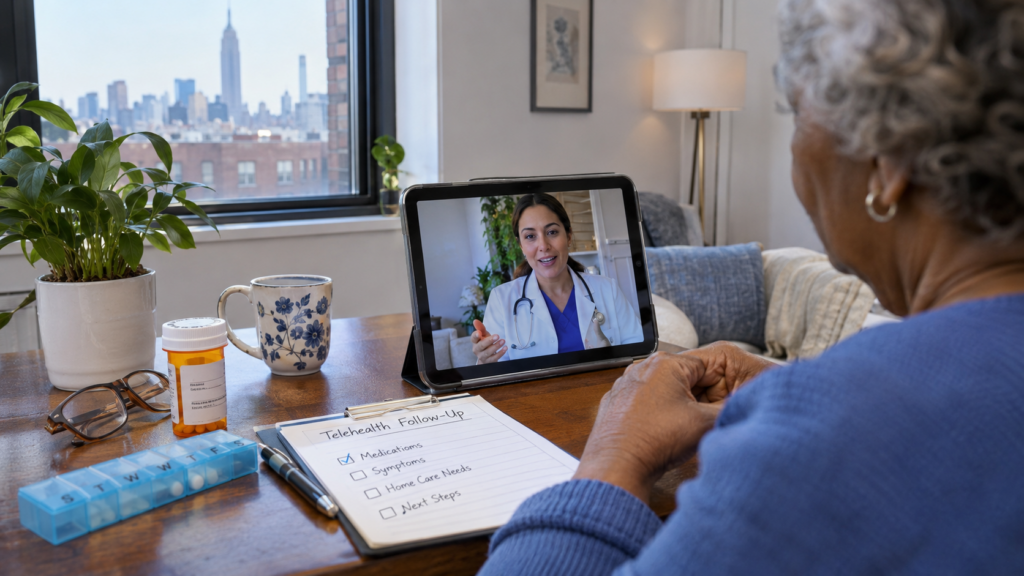
Many home care patients now see their doctor on a tablet or phone. That can save a hard trip across the city. This guide explains the New York Medicaid telehealth rules that matter most to patients at home and their families. We checked each fact against official sources in November 2026. Where a rule is unclear, we say so.
Here is the short version. New York Medicaid covers video visits, phone-only visits in some cases, and some home health monitoring. You can usually take these visits from home. However, telehealth does not replace the hands-on help a home health aide gives you.
What New York Medicaid telehealth covers
The Department of Health telehealth page lists four types of telehealth that Medicaid covers:
- Video visits: you see and talk to your provider in real time.
- Audio-only visits: a phone call with no video.
- Remote patient monitoring: a device at home sends health readings to your care team.
- Store-and-forward: photos or test results get sent for a provider to review later.
The details sit in the state’s Medicaid Telehealth Policy Manual. The newest version took effect on July 29, 2026. In addition, the August 2026 Medicaid Update lists what changed. For example, it updated the end dates for Medicare rules and for payment parity.
You can have a telehealth visit from home
Under the manual, the “originating site” is simply where you are during the visit. Your home counts. Doctors even use a billing code that shows the patient was at home.
Many kinds of providers can offer telehealth. State law lists doctors, nurse practitioners, nurses, therapists, social workers, and home care agencies, among others. The provider must hold a New York license and enroll in Medicaid to bill for your visit. Also, the visit must be private and secure under federal privacy rules.
When phone-only visits are covered
Not everyone has a smartphone or good internet. So New York Medicaid telehealth rules cover audio-only visits in some cases. The manual lists these conditions:
- Video is not possible because you lack the device or connection, or you prefer a phone call.
- Your provider still offers a video or in-person visit if you ask.
- Your provider decides the care works well without video.
- The visit includes everything a regular visit would.
The state also says phone-only visits should be rare for medical care. For example, a storm might keep you from using video. Phone visits are more common for mental health care. The state regulation also requires your consent to a phone-only visit.
Payment parity runs until April 1, 2028
Payment parity is a key part of New York Medicaid telehealth. It means Medicaid pays for a telehealth visit at the same rate as an in-person visit. This matters because it keeps providers willing to offer video visits. The telehealth manual says this law now lasts until April 1, 2028.
There is one catch. Some clinics cannot charge a facility fee when neither you nor the provider was at the clinic. That does not change what you pay, though. It only affects how the clinic bills Medicaid.
Remote patient monitoring at home
Remote patient monitoring, or RPM, lets your care team track your health between visits. For instance, a blood pressure cuff or glucose meter can send readings to your doctor. Under the manual, Medicaid covers RPM when:
- A doctor or other qualified provider orders it.
- The device is an FDA medical device.
- You give consent before each episode of care.
- Your provider reviews and records what the readings mean.
There was also a 2026 change. Starting January 1, 2026, Medicaid pays for shorter monitoring periods, according to the March 2026 Medicaid Update. Now it covers as few as 2 to 15 days of readings in a month. It also covers 10 to 19 minutes of staff time. As a result, short check-ins after a hospital stay may be easier to cover.
Telehealth cannot replace your home health aide
This is the most important New York Medicaid telehealth rule for home care families. The state says home care agencies may not use telehealth:
- As a substitute for in-person personal care from a licensed home care agency.
- For the first in-person medical or clinical assessment.
- For the Functional Supplement part of the state’s home care assessment.
- When the patient cannot get to a private, secure spot.
These limits come from the manual and the Department of Health’s 2024 letter to home care agencies. That letter also asks agencies to train patients and families on the technology and to record consent.
What about nurse visits that supervise aides? State rules say a registered nurse supervises home health aides. The nurse also makes in-home visits in certain cases, such as when a new aide starts or your condition changes. Current guidance does not clearly say which of these visits may happen by video. So ask your agency how it handles nurse visits. For CDPAP, we did not find a separate telehealth rule.
Our guide to what a home health aide can do explains the hands-on help an aide gives.
How a home health aide can help with video visits
An aide cannot give medical advice during your visit. Still, an aide can make the visit go more smoothly. Here are some ways an aide can help:
- Charge the tablet or phone before the visit.
- Set up a quiet, well-lit spot with good signal.
- Help you sit up and get comfortable.
- Turn up the volume or help with captions.
- Keep your pill bottles and questions close by.
- Help you use a blood pressure cuff if your care plan includes it.
- Write down the next steps your provider gives you.
Your aide should follow the care plan your nurse sets. Also, let your agency know if you want help with telehealth so they can add it to the plan.
Medicare rules for people with both Medicare and Medicaid
Many home care patients have both Medicare and Medicaid. New York Medicaid telehealth rules work alongside Medicare. For care that Medicare covers, Medicare’s telehealth rules apply first. According to Telehealth.HHS.gov, Medicare’s expanded telehealth rules now run through December 31, 2027. Until then:
- You can get Medicare telehealth at home, wherever you live.
- Medicare allows phone-only visits for many services.
- Mental health telehealth at home is permanent.
After 2027, Congress would need to act again. Until then, these rules stay in place. The New York manual confirms the December 31, 2027 date.
Tips for families
- Ask your doctor’s office if your next visit can be by video.
- Tell them if you need a phone visit instead.
- Test the app or link a day early.
- Keep your Medicaid and Medicare cards handy.
- Ask your health plan which New York Medicaid telehealth services it covers.
Coming home from the hospital? Our hospital discharge guide can help you plan. You can also read about New York Medicaid changes in 2027.
This article is general information, not medical or legal advice. Rules can change. For your own care, talk with your doctor, your health plan, or your local Medicaid office.
Want an aide who can help with video visits and daily care? Contact Nursing Personnel Home Care or call 718-218-8991. Since 1996, we have served all five boroughs and Nassau County. We also hold accreditation from The Joint Commission.
Frequently asked questions
Does New York Medicaid telehealth cover visits from home?
Yes. Your home can be the place you take a covered telehealth visit.
Will Medicaid pay for a phone-only visit?
Sometimes. It covers phone visits when video is not possible or you prefer a call. Your provider must also decide the care works without video.
Can a video visit replace my home health aide?
No. State rules say telehealth cannot replace in-person personal care from a licensed home care agency.
How long will telehealth pay the same as in-person care?
The New York payment parity law runs until April 1, 2028.
I have Medicare too. Can I still have video visits at home?
Yes. Medicare’s expanded telehealth rules run through December 31, 2027.